Geomorphometry Newsletter February 2011

Published: Feb 15, 2011 by ISG Board

Geomorphometry 2011: Second Call for papers

The third Geomorphometry conference will be held in September 7-11, 2011 (Wednesday to Sunday) at the ESRI Campus Redlands, California, USA. Prospective authors are invited to submit extended abstracts of up to 4 pages (ca 2000 words) by 1st of March 2011. Extended abstracts must be original works by the authors, not be currently under review in the same form by another outlet and not submitted elsewhere prior to the notification date. The conference will host 6 keynotes plus 38 oral talks and a number of posters. In addition, three 2-day workshops will be held immediately after the conference (Saturday/Sunday; Redland Campus). Registration fees for the conference are $375 USD ($200 USD for PhD students). There are 23 days left to submit an extended abstract. For more info visit the official website: http://geomorphometry.org/2011

To submit an extended abstract, follow the author guidelines published at http://geomorphometry.org/content/manuscript-preparation-guidelines; abstracts (line numbered PDF) can be submitted via the EasyChair system at: http://www.easychair.org/conferences/?conf=geomorphometry2011


9 PhD Scholarships in GIScience, Salzburg, Austria
Doctoral College - DK-GIScience Salzburg in Austria has recently published an open call for 9 PhD Scholarships in the field of GIS Science. Requirements include the excellent completion of a degree at the Masters level in Geoinformatics, Geomatics, Geography, Computer Science or any scientific/technical subject in a relevant field, and excellent English language (both oral and writing) skills.

Annual brutto salary: 26.278 Euro per year (Gross)
Job duration: 3 years
For all inquiries, please contact giscience@sbg.ac.at


OpenTopography - publicly available elevation data
San Diego Supercomputer Center, University of California has recently launched a portal to share High-Resolution Topography Data and Tools. Visit http://www.opentopography.org to obtain the publicly available data sets and tools. At the moment the portal offers a large number of LiDAR surveys (mainly in USA) and will hopefully lead to complete-coverage publicly available elevation data sets.

Geomorphometry is the science of quantitative land-surface analysis (also known as the science of DIGITAL TERRAIN MODELLING AND ANALYSIS). The focus of geomorphometry is calculation of surface-form measures (land-surface parameters) and features (objects), which may be used to improve the mapping and modelling of landforms, soils, vegetation, land use, natural hazards, and other information.

newsletter

Share

Latest Posts

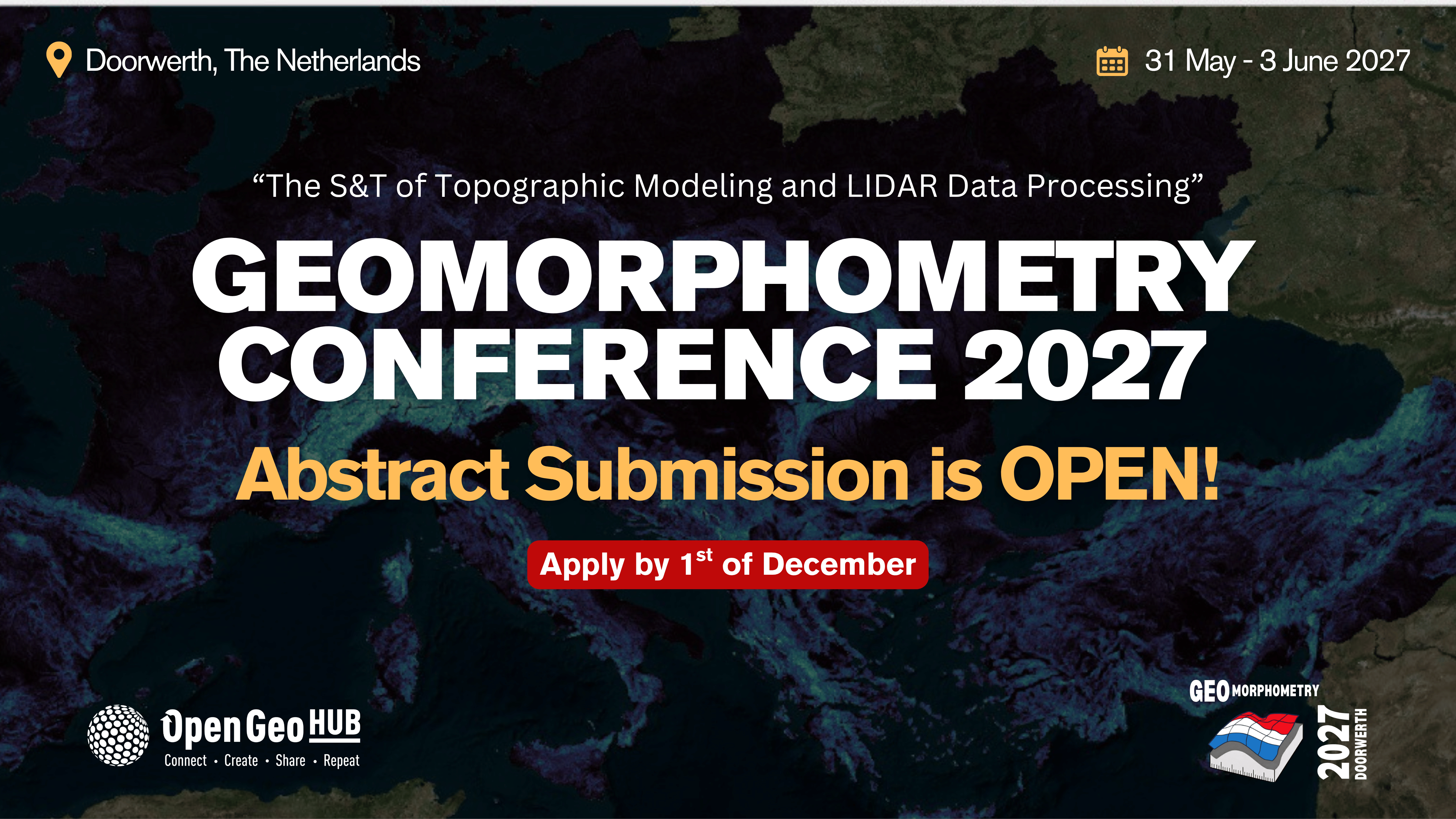
Geomorphometry 2027 - Abstract submission now open

We are excited to announce that abstract submission is now open for the Geomorphometry Conference 2027, “The S&T of Topographic Modelling and LIDAR Data Processing.”

📅 31 May–3 June 2027 📍 Doorwerth, The Netherlands

The conference programme will feature oral presentations, workshops, poster sessions, providing opportunities to share research, exchange ideas and connect with the geomorphometry community.

📣 Interested in contributing? Submit your abstract for an oral presentation, workshop or poster by 1 December 2026: https://pretalx.earthmonitor.org/geomorphometry-conference-2027/cfp

Please note that, if your abstract is accepted, you will be required to submit a “four-page full paper” as part of the second phase of the submission process. The deadline for the full paper submission is 1 March 2027.

For more information about the conference, please visit the official conference website: https://opengeohub.org/events/geomorphometry-conference-2027

🔎 This conference is hosted by the OpenGeoHub Foundation.

👉 Submit your abstract and join us in Doorwerth in 2027!

Whitebox Workflows Next Gen released

Whitebox Workflows Next Gen, a complete rewrite of the Whitebox geospatial analysis platform, is now publicly available for Python, R, and QGIS.

Built from the ground up in pure Rust, Whitebox Next Gen provides more than 700 geospatial analysis tools for geomorphometry, terrain analysis, spatial hydrology, LiDAR processing, remote sensing, vector GIS, and spatial statistics. All three interfaces run on the same high-performance backend, allowing users to work in scripts, notebooks, statistical workflows, or a familiar desktop GIS environment.

Whitebox Next Gen is not an incremental update to the previous Whitebox architecture. It replaces the earlier monolithic system with a modular, full-stack geospatial platform. Core capabilities for raster and vector I/O, coordinate systems and reprojection, vector topology, spatial indexing, LiDAR processing, and other foundational operations are implemented directly within the Whitebox codebase rather than delegated to external C or C++ GIS libraries. This approach provides consistent cross-platform behaviour, fewer system-level dependencies, tighter control over performance and correctness, and greater flexibility for continued research and development

Highlights

  • More than 700 tools for geomorphometry, hydrology, LiDAR, remote sensing, vector analysis, spatial statistics, and general geospatial processing
  • Publicly available interfaces for Python, R, and QGIS
  • A modular, high-performance backend written entirely in Rust, including wbprojection, wbraster, wbvector, wblidar, wbspatialstats, and wbtopology open-source (MIT/Apache licensed) backend libraries
  • Most of the 80+ tools that existed within the previous extension product have been migrated to the new Whitebox open core, including the tools for advanced surface curvature analysis and DEM processing
  • Native coordinate-reference-system handling and reprojection workflows via wbprojection
  • Expanded raster support (19 formats), including GeoTIFF, Cloud-Optimized GeoTIFF (COGs), GeoPackage Raster, and JPEG2000
  • Expanded vector support (12 formats), including Shapefile, GeoPackage, FlatGeobuf, GeoParquet, GeoJSON, TopoJSON, and GML
  • Modern point-cloud support, including LAS, LAZ, COPC, E57, and PLY
  • A dedicated topology engine supporting robust vector analysis, network analysis, route-event workflows, and linear referencing
  • Local-first processing on Windows, macOS, and Linux
  • A consistent analysis platform across Python scripts and R workflows
  • A newly updated and more advanced QGIS Processing toolbox

Whitebox has particular strengths in terrain analysis, geomorphometry, spatial hydrology, and LiDAR processing. Whitebox Next Gen carries these areas forward while substantially expanding the project’s capabilities for vector analysis, remote sensing, modern spatial data formats, and reproducible geospatial workflows.

Get started

The geomorphometry community is invited to explore Whitebox Next Gen, test its tools and workflows, report issues, and contribute to the continued development of the project.

DEMIX reveals which DEMs perform best

First round of the DEMIX exercise published final report

Global digital elevation models (DEMs) have become routine operational inputs across mapping, environmental monitoring, modelling and Earth-observation workflows. Their broad coverage and global availability have made them data that many practitioners simply take for granted. But knowledge of the terrain and topography of Earth’s surface is fundamental for monitoring and understanding terrestrial ecosystems and the planet’s habitability. For that reason, the CEOS Working Group on Calibration and Validation (WGCV) maintains a subgroup dedicated to digital topography and the quality of DEMs, the ‘Terrain Mapping Sub-Group (TMSG).

DEMs are representations of elevation in the form of a georectified grid, at global scale commonly derived from space-based interferometric synthetic aperture radar (InSAR) or stereoscopic optical observations, while regionally and locally airborne Laser induced detection and ranging (LIDAR) has become the primary source. DEMs can be classified as digital surface models (DSMs) when depicting the lower surface of the atmosphere or digital terrain models (DTMs) when depicting the top of the lithosphere (the Earth’s crust).

A wide variety of DEM products exist – each having different characteristics which suit different applications. It can be challenging to understand which of the available DEM products are fit for purpose for certain applications or regions. That is the practical gap addressed by the Digital Elevation Model Intercomparison Exercise (DEMIX) undertaken by TMSG. By exposing where widely used global DEMs agree, where they differ and how those differences affect rankings, the exercise delivered evidence to users for selecting a DEM rather than defaulting to one by habit.

DEM products were compared through a ‘wine contest,’ which identified requirements of openness, reproducibility, adaptability, and statistical rigour. The characteristics, evaluations, and ranking for each DEM were collected in a GIS database with over 50,000 entries. A quantitative assessment was carried out for each global DEM based on pixel-by-pixel differences of geomorphometric parameters against finer spatial resolution (1-5 m resolution) reference DEMs.

The study incorporates an unprecedented amount of high quality reference data covering a broad range of landforms and surface types, comparing their characteristics without resampling or interpolation. Users are invited to consult the results of DEMIX in order to make informed choices when needing to use a DEM, or in some cases a combination of the most relevant DEMs for their applications.

The final rankings of the wine contest, presented below, compared the six DEMs based on land cover (forest, urban, or barren), slope (cliff, steep, gentle, or flat), differences in elevation, slope and roughness, and statistical metrics.

Led by the European Commission’s Joint Research Centre (JRC), the CEOS Working Group on Calibration and Validation (WGCV) Terrain Mapping Subgroup (TMSG) established DEMIX in partnership with the International Society for Geomorphometry. Several members of the International Society of the Geomorphometry contributed significantly and we hosted various secssions at our latest conference. The exercise was performed over a three-year period starting in 2020, with community-wide calls for participation and an assembly of experts producing a number of peer-reviewed publications, culminating with a JRC reference report published in July 2026.

The objective of DEMIX was to propose a procedure to rank the available free and open global DEMs, taking into consideration user needs while promoting the implementation of FAIR (Findable, Accessible, Interoperable and Reusable) principles. The exercise compared DEMs based on criteria for land cover and terrain slope categories, representative testing, and a statistically sound ranking approach. The report outputs tailored recommendations regarding available DEM products that are not limited to one domain, geographic area, or landscape type, with flexibility for different user needs and applications.

A major challenge in the comparison of the global DEMs were the varying formats, data, and metadata contents. The adoption of a common set of standards would enhance the quality and interoperability of global DEMs and streamline the exchange and utilisation of DEM data for both providers and users. DEMIX makes the following recommendations for data providers:

● Adopt a standardised grid layout, with complete grid definitions and encodings following ISO/OGC rules.

● Include vertical datum information as part of raster DEM files.

● Clearly indicate the product version in the file names.

● Participate in future DEMIX rounds, which serve as a neutral platform for independently evaluating products before their release.

● Provide high quality, finer resolution, accurate, and multi-temporal elevation data to be used as a reference alongside DEM products.

Global DEMs are indispensable operational geospatial datasets, but they should not be treated as error-free or interchangeable. DEMIX delivered to the global community a systematic and transparent method to help choose elevation products more intelligently and help define what better elevation measurements should look like in the future.

Further Reading:

Read more in the DEMIX Final Report, or see other DEMIX publications below - mainly by our ISG members:

  • Benchmarking Elevation Plus Land Surface Parameters Finds FathomDEM and Copernicus DEM Win as Best Global DEMs (2025) and subsequent discussion (2026a, 2026b)
  • Ranking of 10 Global One-Arc-Second DEMs Reveals Limitations in Terrain Morphology Representation 2025
  • Novel Approach for Ranking DEMs: Copernicus DEM Improves One Arc Second Open Global Topography (2024)
  • Digital Elevation Models: Terminology and Definitions (2021)
  • The Digital Elevation Model Intercomparison eXperiment DEMIX, a community-based approach at global DEM benchmarking (2021)